
By Rahul Desai
Founder – RD Consultancy | CEO & MD – International Institute of Gemology (IIG)
Walk into any jewellery showroom today and you’ll notice something fascinating.
Two customers may stand in front of the same diamond necklace. They may belong to the same age group, have similar incomes and even share the same budget. Yet one walks away delighted, while the other leaves unconvinced.
Why?
Because they were never buying the same thing.
One was investing in a family legacy. The other was looking for a way to express her personality.
This is the biggest misconception in jewellery retail today—we classify customers by age, income or occasion, when we should be understanding them by motivation.
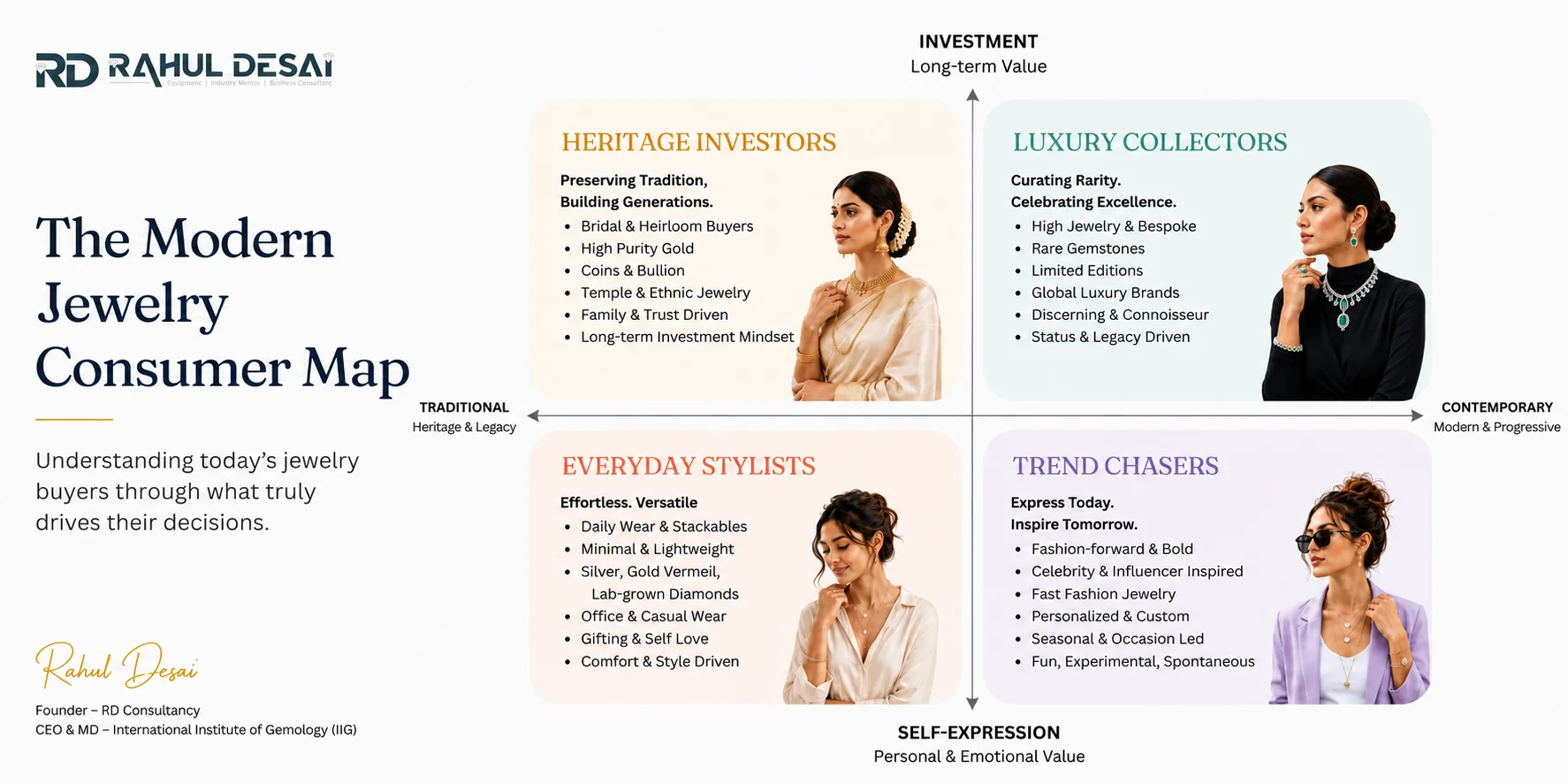
After working with thousands of retailers and studying consumer behaviour across India, I realised that the most successful jewellery businesses don’t just sell products. They understand why people buy jewellery. That insight led to the development of The Modern Jewellery Consumer Map—a strategic framework designed to help retailers identify the psychology behind every purchase.
Beyond Demographics: The Shift Every Retailer Must Make
For decades, jewellery retailers have segmented customers using traditional variables:
- Age
- Gender
- Income
- Occupation
- Geography
These factors tell us who the customer is.
They rarely explain why the customer buys.
A 30-year-old entrepreneur purchasing a solitaire ring for herself behaves very differently from a 30-year-old groom buying wedding jewellery. Their demographics are identical, but their motivations are worlds apart.
Modern retail demands behavioural segmentation rather than demographic segmentation.
That is where competitive advantage begins.
The Two Forces That Shape Every Jewellery Purchase
Every jewellery buying decision is influenced by two fundamental dimensions.
The first is Investment vs. Self-Expression.
Some consumers see jewellery as a long-term asset, a store of value and a family heirloom. Others see it as an extension of their personality, style and identity.
The second dimension is Traditional vs. Contemporary.
Some buyers are deeply influenced by heritage, rituals and family values. Others embrace modern aesthetics, experimentation and evolving lifestyles.
When these two dimensions intersect, four distinct consumer mindsets emerge.
The Four Modern Jewellery Consumers
-
Heritage Investors
These customers buy jewellery to preserve wealth, celebrate traditions and build a legacy for future generations.
For them, trust matters more than trends.
They seek timeless craftsmanship, purity, authenticity and emotional security.
Selling to them requires patience, credibility and storytelling around heritage.
-
Luxury Collectors
Luxury Collectors are not simply purchasing jewellery—they are curating excellence.
They appreciate exceptional craftsmanship, rare gemstones, bespoke creations and exclusivity.
Price is rarely their first question.
Their first question is often, “What makes this piece special?”
Knowledge becomes the salesperson’s greatest asset.
-
Everyday Stylists
Jewellery has become part of everyday fashion.
This growing segment purchases pieces that complement workwear, travel, social occasions and personal style.
They value versatility, comfort and practicality.
Rather than waiting for weddings or festivals, they celebrate themselves.
For retailers, this represents one of the fastest-growing repeat-purchase opportunities.
-
Trend Chasers
This is the consumer shaped by Instagram, Pinterest, celebrities and digital culture.
They enjoy novelty, bold designs and seasonal collections.
Jewellery becomes a form of self-expression rather than long-term ownership.
Winning this customer requires speed, fresh collections and a strong digital presence.
Why This Framework Changes Retail Strategy
Understanding these four consumer mindsets transforms far more than the sales conversation.
It influences:
- Inventory planning
- Visual merchandising
- Store design
- Marketing communication
- CRM strategy
- Digital campaigns
- Staff training
- Leadership decisions
Instead of asking, “Which products should we stock?” retailers begin asking, “Which consumers do we want to serve?”
That single shift changes the entire business.
The Future Belongs to Consumer-Centric Retailers
The jewellery industry has spent decades becoming experts in diamonds, gemstones, gold purity and manufacturing.
The next decade belongs to retailers who become experts in human behaviour.
Technology can replicate products.
Competitors can match prices.
Designs can be copied.
But understanding your customer better than anyone else is a competitive advantage that is extremely difficult to imitate.
That is the philosophy behind The Modern Jewellery Consumer Map.
It is not merely a marketing model.
It is a management framework that helps jewellery businesses align their strategy, inventory, customer experience and leadership around one simple principle:
People don’t buy jewellery because it shines. They buy it because it reflects something within themselves.
The retailers who recognise this shift won’t just sell more jewellery.
They will build stronger brands, deeper relationships and businesses designed for the future.