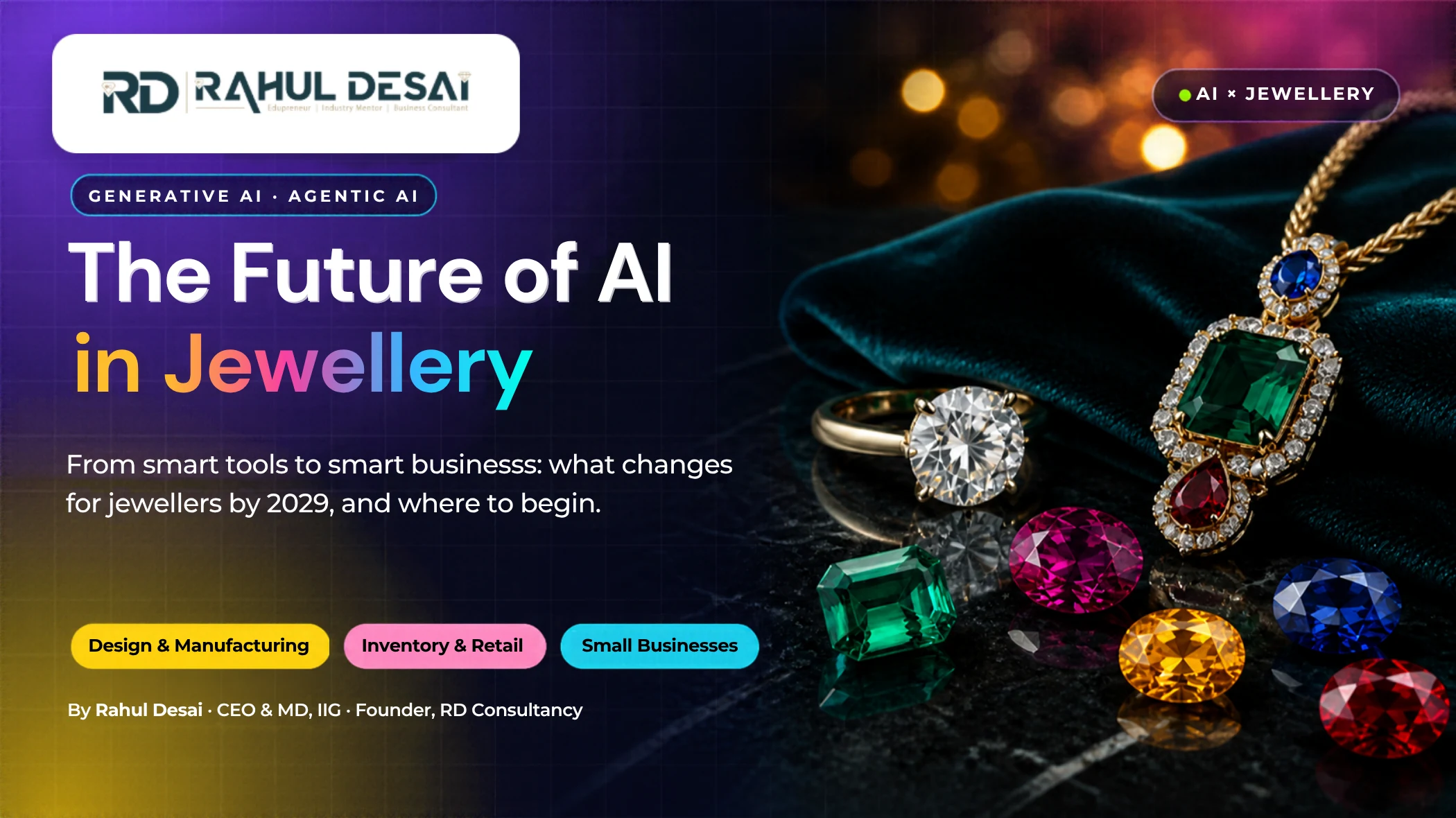
How generative AI and intelligent agents can help businesses work smarter while keeping people in charge
A missed follow-up. Unsold stock. A smarter way forward.
Your best-selling design may sit unsold in one showroom while another store turns customers away. A promising enquiry may also be waiting for a follow-up. These everyday gaps cost jewellery businesses money and trust.
Artificial intelligence is moving from tools that answer questions to systems that complete useful work. Over the next few years, it could help jewellery businesses make better decisions, reduce waste and serve customers thoughtfully. Success will depend on good information, safeguards and human judgement.
I’m Rahul Desai, an educator and entrepreneur in the gems and jewellery trade. I serve as CEO and Managing Director of the International Institute of Gemology (IIG), and I founded RD Consultancy, where I advise jewellery businesses. I train and advise retail and wholesale teams across administration, sales, inventory and management, so I see where practical technology can help.
Generative AI vs Agentic AI in the Jewellery Industry
Generative AI is like a fast creative assistant. It can draft product descriptions, suggest designs, write campaigns or summarise reports. It responds to the task you give it.
Agentic AI goes a step further. Given a goal and clear boundaries, it can plan tasks, use approved software and check its work. For a festive campaign, a writing tool drafts the message; an agent connected to stock and customer records could identify products, prepare personalised drafts, suggest store transfers and track results.
People still approve budgets, discounts and use of customer information.
Four Key Applications of AI in the Gems and Jewellery Industry
Design and manufacturing. AI can help designers explore variations and spot emerging styles. When connected to computer-aided design and production information, it may also help teams refine designs, reduce material waste and plan workloads. In diamond manufacturing, image analysis can support stone assessment and yield planning. In workshops, production data can reveal bottlenecks or warn that a delivery may be late. Still, a striking computer-generated design may not be practical to make. Strength, setting, metal properties and craftsmanship matter.
Inventory and pricing. Stock that sits for months ties up cash. AI can review sales, seasons, enquiries, margins and stock age to flag slow movers, guide reorders and suggest promotions or transfers. Even a weekly review of stock age, margin and sell-through helps. Reliable records come first.
Personal retail, Jewellery marks meaningful moments. With consent and accurate records, AI can help remember preferences, suggest designs, support virtual try-ons and prompt follow-ups. A salesperson could prepare engagement ring options matching a customer’s stated budget and taste. But software cannot understand a family’s hopes or build confidence in a high-value purchase. Personal service depends on people.
Connected teams of agents. A manufacturer might use agents to forecast sales, check materials, plan production, prepare purchase suggestions and track deliveries. A dashboard could show delays and decisions needing approval. Errors can spread through connected systems, so spending, supplier choices, price exceptions and quality sign-offs need human oversight.
How Small Jewellery Businesses Can Start Using AI
Independent designers, wholesalers and family-run shops can use AI for product descriptions, multilingual marketing, enquiry replies, follow-up reminders, stock reviews, weekly business summaries and routine reports.
Choose one costly problem, such as missed follow-ups or poor stock visibility. Record the current result, try a tool and measure the difference. At RD Consultancy, I ask: ‘Where are you losing time or money today?’ The problem comes first; the tool comes second.
Data Requirements and AI Safety in Jewellery Businesses
AI is only as useful as the information it can rely on. Records are often scattered across billing systems, spreadsheets and messages. Missing or inconsistent details can produce misleading recommendations.
Keep product details, weights, purity, gemstone information, costs and prices accurate. Use relevant customer records with consent. Maintain dependable sales, margin and payment data, and track production times, wastage and quality issues where useful. Set access rules, approval limits and a log for important automated actions.
Keep information accurate, useful and safe. Businesses often gain fastest when administration, sales and inventory teams share dependable records. That is why IIG and RD Consultancy training builds data habits alongside AI skills.
Will AI Replace Jewellery Designers, Gemologists and Sales Professionals?
A more useful question is: which tasks can AI handle, and where must a person stay in charge? AI can support analysis, research, forecasting and administration, helping professionals find relevant information.
People must verify gemstone and treatment claims, handle difficult grading decisions, protect ethical sourcing, practise skilled craftsmanship and build customer relationships. AI can be wrong, especially with incomplete records. Check generated images and product descriptions so customers are not misled.
In jewellery, trust is part of the product. Professionals who pair product knowledge with digital skills and sound judgement will use AI best.
AI Adoption Roadmap for Jewellery Businesses (2026–2029)
Start by organising product, customer, stock and financial data; use AI for content and routine administration. Then connect suitable tools to business systems, with a person reviewing forecasts and follow-ups. Test agents on reversible, low-risk tasks. Measure impact before expanding.
Track stock age, margin, enquiry conversion, response time, production lead time, wastage or repeat purchases. Compare with your starting point. The 2026–2029 timeline is a guide, not a promise of autonomy; move at a pace that matches readiness and risk.
Preparing Jewellery Professionals for an AI-Driven Future
Jewellery education must evolve with the industry. At IIG, we prepare people who understand gemstone science and trade realities. Future professionals will need to read data, question AI recommendations, use digital product information and apply new tools responsibly.
These skills strengthen gemmology and craftsmanship. For owners, knowing which questions and numbers matter is as valuable as using an AI app.
The Future of AI in Jewellery: Why Human Expertise Still Matters
AI is moving towards systems that analyse information, coordinate work and pursue goals within limits. This creates opportunities in design, manufacturing, inventory, retail, education and management.
Adopt AI to solve a real problem. Start small, organise data, train people, set safeguards and measure results. A large company may build agents; a family shop may start with an assistant and a clearer stock sheet.
Jewellery will always depend on beauty, authenticity, craftsmanship and trust. AI can improve responsiveness and efficiency, while human judgement ensures genuine value. Begin by naming the biggest problem in your day-to-day work.
Frequently asked questions
What is agentic AI in the jewellery industry?
It plans and carries out tasks towards a goal, such as monitoring stock or coordinating production, within business-set permissions.
How can a small jeweller use AI?
Use it for product descriptions, follow-ups, stock reviews or reports. Start with a repetitive, measurable problem.
Can AI improve jewellery inventory management?
It can guide reorders and transfers using sales, stock age and margins, if the underlying records are accurate.
Will AI replace designers, gemmologists or salespeople?
AI may change tasks, but expertise, craftsmanship, relationships and accountability remain essential.
How should a jewellery business prepare for agentic AI?
Organise data, set a measurable goal and define privacy and approval rules. Test low-risk tasks first.
What is the biggest AI opportunity for the industry?
Connecting business information to reduce waste and make customer experiences more relevant.