
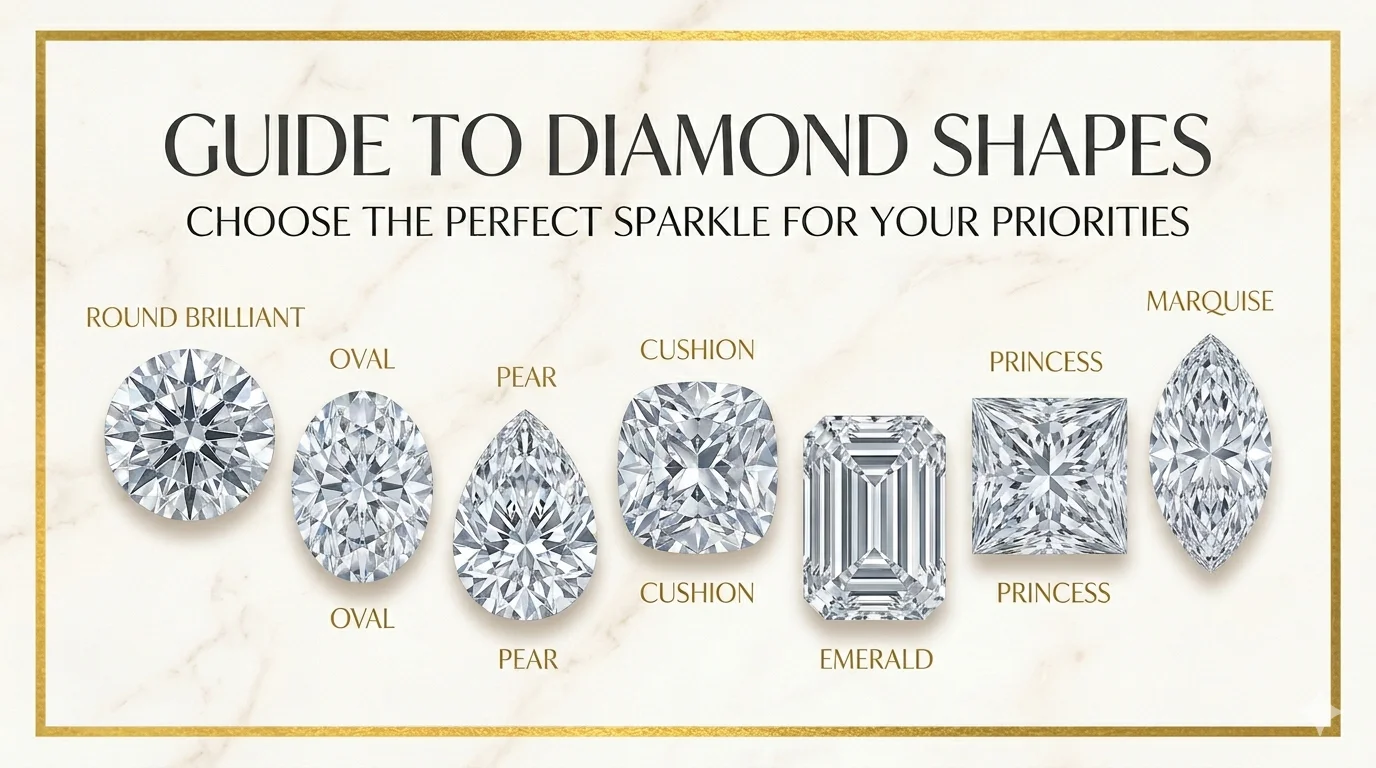
There’s no single “best” diamond shape — only the best shape for your priorities. Round brilliant delivers the most sparkle and is the safest universal choice. Oval, pear, and marquise look larger than their carat weight and elongate the finger. Cushion balances vintage softness with strong light performance. Emerald and princess suit those who want clean geometric lines, though each comes with a specific trade-off in clarity needs or durability. The right choice comes down to four factors: sparkle preference, finger/hand shape, lifestyle and durability needs, and budget per carat.
Diamond Shape vs. Diamond Cut: What’s the Difference?
Buyers often use “shape” and “cut” interchangeably, but gemologically they’re different things.
- Shape refers to the diamond’s outline — round, oval, pear, and so on.
- Cut refers to how well the diamond’s facets are proportioned and angled to return light — graded independently as Excellent, Very Good, Good, Fair, or Poor.
A diamond can have a beautiful shape and still be a poor cut, or vice versa. This matters because GIA’s formal Cut grade only applies to standard round brilliant diamonds. Fancy shapes (oval, pear, emerald, cushion, princess, marquise) don’t have a single standardized “ideal” proportion the way round brilliants do, so they’re assessed more individually on proportions, symmetry, and polish. This is one reason buying a fancy-shape diamond benefits from a trained eye or a certified report you actually understand — not just a grade on paper.
The 7 Most Popular Diamond Shapes — Pros, Cons, and Who Each One Suits
Round Brilliant
The round brilliant is cut with 58 facets engineered over decades of optical research to maximize light return — which is why it remains the highest-sparkle, most universally flattering shape available.
Pros: Maximum brilliance and fire; hides minor inclusions well; timeless resale and exchange value; widest availability across budgets. Cons: Highest price per carat among all shapes; least amount of “rough” diamond wastage avoided during cutting (explained in the budget section below); can look less distinctive on the hand. Best for: Buyers who prioritize sparkle and a classic, safe choice above all else.
Oval
An elongated brilliant cut that combines round-level sparkle with a slimming silhouette.
Pros: Looks notably larger than its actual carat weight; elongates the finger; strong brilliance, close to round-level performance. Cons: Can show a “bowtie” effect — a dark, bowtie-shaped shadow across the center caused by light leakage through the pavilion — more visible in poorly proportioned stones. Best for: Buyers wanting a larger visual size for the budget, and those with shorter or wider fingers seeking an elongating effect.
Pear
A teardrop hybrid of round and marquise shapes, worn with the point facing the fingertip.
Pros: Distinctive and romantic silhouette; elongates the finger more than almost any other shape; appears larger than its carat weight. Cons: The pointed tip is the most vulnerable part of the stone and needs a protective V-prong setting; can also show bowtie effect; symmetry must be precise or the shape looks lopsided. Best for: Buyers wanting a distinctive, finger-lengthening shape — paired with a secure setting (see our setting guide).
Cushion
A square or rectangular shape with softly rounded corners and larger, more open facets than a round brilliant — giving it a romantic, slightly vintage character.
Pros: Strong brilliance with a softer, more “antique” sparkle pattern; rounded corners are naturally chip-resistant; hides minor inclusions reasonably well. Cons: Can appear smaller face-up than its carat weight compared to elongated shapes; less standardized proportions across cutters, so quality varies more. Best for: Buyers who want vintage character without sacrificing too much brilliance or durability.
Emerald
A rectangular step cut — long, open facets arranged in parallel rows rather than the triangular facets of a brilliant cut, producing a “hall of mirrors” optical effect instead of sparkle.
Pros: Sophisticated, architectural look; shows off a high-clarity stone beautifully; typically more budget-efficient per carat than round. Cons: The open facets expose inclusions and color tint far more readily than a brilliant cut — buyers should prioritize a higher clarity grade (VS1 or better) and better color grade than they might choose for a round or cushion stone. Best for: Buyers who value clean, geometric elegance and are willing to pay for higher clarity to support the shape’s transparency.
Princess
A square brilliant cut, combining brilliant-style faceting with crisp, geometric corners.
Pros: High brilliance, close to round-level sparkle; generally less expensive per carat than round; modern, architectural look. Cons: Sharp corners are the most chip-prone of any shape and require a protective setting (corners enclosed in metal or V-prongs); slightly more visible inclusions near the corners. Best for: Buyers who want strong sparkle in a more geometric silhouette, paired with a corner-protecting setting.
Marquise
An elongated shape with two symmetrical pointed ends — historically one of the most finger-lengthening shapes in existence.
Pros: Maximizes apparent size and length more dramatically than almost any other shape for its carat weight; distinctive, statement-making silhouette. Cons: Both pointed tips are vulnerable to chipping and need protective prongs; can show bowtie effect; symmetry is unforgiving — even slight asymmetry is easy to spot. Best for: Buyers wanting maximum finger elongation and a bold, less common silhouette.
Shape Comparison at a Glance
| Shape | Brilliance | Visual Size vs. Carat | Hides Inclusions | Durability/Chip Risk | Typical Price vs. Round |
| Round | Highest | Standard | Good | Low risk | Highest |
| Oval | High | Larger | Good | Low risk | 10–25% less |
| Pear | High | Larger | Good | Tip is fragile | 15–25% less |
| Cushion | Moderate–High | Standard–Slightly larger | Moderate–Good | Low risk (rounded corners) | 15–25% less |
| Emerald | Lower (different “flash” style) | Larger | Poor — needs high clarity | Low risk | 20–30% less |
| Princess | High | Standard | Moderate | Corners fragile | 15–25% less |
| Marquise | High | Largest | Good | Tips fragile | 20–30% less |
(Writer/dev note: figures are general industry ranges, not fixed prices — verify current ranges with IIG faculty or retail partners before publishing, and consider marking this table up with schema.org Table/FAQ structured data for AEO visibility.)
How Diamond Shape Affects How It Looks on Your Hand
Which diamond shapes make fingers look longer? Elongated shapes — oval, pear, marquise, and emerald — create a visual lengthening effect because their length-to-width ratio draws the eye along the finger rather than across it. This is especially noticeable on shorter or wider fingers.
Which shapes suit a more compact, classic look? Round, cushion, and princess sit in a more proportionate, symmetrical footprint on the hand. They don’t elongate, but they also don’t risk looking “too long” on someone with longer fingers who prefers a balanced look.
What about larger knuckles? As covered in our ring sizing guide, a larger knuckle relative to the finger base affects comfort regardless of shape — but flatter, lower-profile shapes (emerald, cushion) tend to sit more comfortably over a prominent knuckle than tall, domed round brilliants.
Diamond Shape and Your Daily Lifestyle
What diamond shape hides flaws (inclusions) best? Brilliant-cut shapes with many small, triangular facets — round, cushion, oval, marquise — scatter light in a way that visually camouflages minor inclusions and faint color tint. This means buyers can often choose a slightly lower clarity or color grade in these shapes and still get an eye-clean look, saving on budget.
What diamond shape exposes flaws most? Step-cut shapes — primarily emerald (and Asscher, if offered) — have large, open, mirror-like facets with nowhere for inclusions to hide. For these shapes, prioritize VS1 clarity or better, and a stronger color grade than you’d need in a brilliant cut.
Which shapes need extra protection for daily wear? Any shape with pointed corners or tips — pear, marquise, and princess — is more vulnerable to chipping during daily activities (cooking, gym, manual work) unless set in a protective setting (V-prongs or a bezel). See our setting guide for how prong, bezel, pavé, and channel settings affect durability.
Practical takeaway by lifestyle:
- Active or manual daily routine: round, cushion, or oval, in a bezel or protected-prong setting
- Mostly occasion wear, lower daily friction: pear, marquise, or princess are more viable
- Budget-conscious, wants flaws hidden: round, cushion, or oval at a lower clarity/color grade
- Wants maximum clarity on display: emerald, paired with a higher clarity grade
Diamond Shape and Budget: Getting More Visual Size for Less
Which diamond shape looks biggest for the price? Elongated fancy shapes — oval, pear, and marquise in particular — have more surface area (table) spread across the same carat weight compared to a round brilliant, so they appear larger face-up for an equivalent price.
Why is round brilliant the most expensive shape per carat? Cutting a round brilliant from typical octahedral rough diamond crystal wastes significantly more raw material than cutting a fancy shape from the same rough. That extra wastage, combined with consistently high demand, is why round brilliants typically carry a noticeable price premium over fancy shapes of equal carat weight and quality — often in the range of 15–30%, though this varies by retailer and market conditions.
Practical budgeting tip: If sparkle is non-negotiable but budget is tight, an oval or cushion in the same quality grade as a round will typically stretch further — both in apparent size and price.
2026 Trend Note: What Are Buyers Actually Choosing This Year?
Search and retail demand data through 2026 consistently show oval and pear shapes leading among elongated cuts, continuing a multi-year shift away from exclusively round and princess shapes toward silhouettes that look larger and more distinctive on the hand. Emerald and cushion are also seeing renewed interest, often paired with hidden-halo or bezel settings for a more modern, lower-maintenance presentation.
That said, trend popularity and personal fit are two different things. A shape’s search volume tells you what other people are choosing this year — not what will suit your hand, lifestyle, or sense of style for the decades you’ll actually wear the ring. Use the trend as information, not a deciding factor.
A Simple Framework for Deciding
Ask these four questions in order:
- Sparkle priority: Do you want maximum brilliance (round, oval, cushion, marquise) or a more architectural “flash” (emerald)?
- Finger/hand shape: Do you want an elongating effect (oval, pear, marquise, emerald) or a balanced, classic footprint (round, cushion, princess)?
- Lifestyle and durability: Is the ring worn daily through manual activity? Favor shapes without exposed points, or commit to a protective setting.
- Budget per carat: Is visual size or shape-purity (round) the priority? Elongated fancy shapes generally offer more visible size per rupee spent.
Frequently Asked Questions
What is the most popular diamond shape for engagement rings? Round brilliant remains the most popular shape overall due to its maximum sparkle and universal appeal, though oval and pear have led growth in demand through 2026.
Which diamond shape looks the biggest for its carat weight? Marquise, pear, and oval shapes appear largest, since their elongated outlines spread more surface area across the same carat weight compared to a round brilliant.
Which diamond shape is the most durable? Round, cushion, and bezel-set shapes with no exposed points are the most chip-resistant for daily wear. Pear, marquise, and princess shapes need protective settings due to their vulnerable points and corners.
Does diamond shape affect price? Yes. Round brilliants typically cost more per carat than fancy shapes of equal quality because cutting a round wastes more rough diamond material during the cutting process.
What diamond shape hides flaws (inclusions) best? Brilliant-cut shapes with many small facets — round, cushion, oval, and marquise — scatter light in a way that visually conceals minor inclusions better than step-cut shapes like emerald.
Which diamond shape suits petite or shorter fingers? Elongated shapes — oval, pear, and marquise — create a lengthening illusion that works particularly well on shorter or wider fingers.
Round vs. oval — which is better? Neither is objectively “better.” Round delivers maximum brilliance and resale familiarity; oval offers a similar level of sparkle with a larger visual footprint and finger-elongating effect, often at a lower price per carat.
What’s trending in diamond shapes for 2026? Oval and pear shapes are leading search and purchase trends in 2026, continuing a broader shift toward elongated silhouettes, often paired with bezel or hidden-halo settings.
Closing
The right diamond shape isn’t the one that’s trending — it’s the one that matches how you want it to look on your hand, how you live day to day, and how far you want your budget to stretch. Once you’ve settled on a shape, the next decisions — clarity and color grade, setting type, and metal — all follow naturally from that first choice.
At IIG India, this kind of shape-and-quality reasoning is exactly what we train diamond graders and gemologists to evaluate professionally. If this level of detail interests you beyond your own ring search, explore our Diamond Grading and Gemology courses.
Internal Links to Include
- → The Solitaire Defined: A Gemological Perspective (already live)
- → Diamond Shapes by Popularity: A Brilliant Spectrum of Choices (already live)
- → Prong, Bezel, Pavé or Channel setting guide (delivered earlier)
- → Ring sizing guide (already live)
- → Solitaire buying guide (when published)