For years, the diamond industry has watched the conversation around lab-grown diamonds evolve from suspicion to curiosity, and now, to acceptance. Although lab-grown diamonds have existed for decades, their commercial and emotional acceptance is relatively recent. In the beginning, the fear was understandable. Many worried about mixing, misrepresentation, price disruption, and what this new category could mean for the future of natural diamonds.
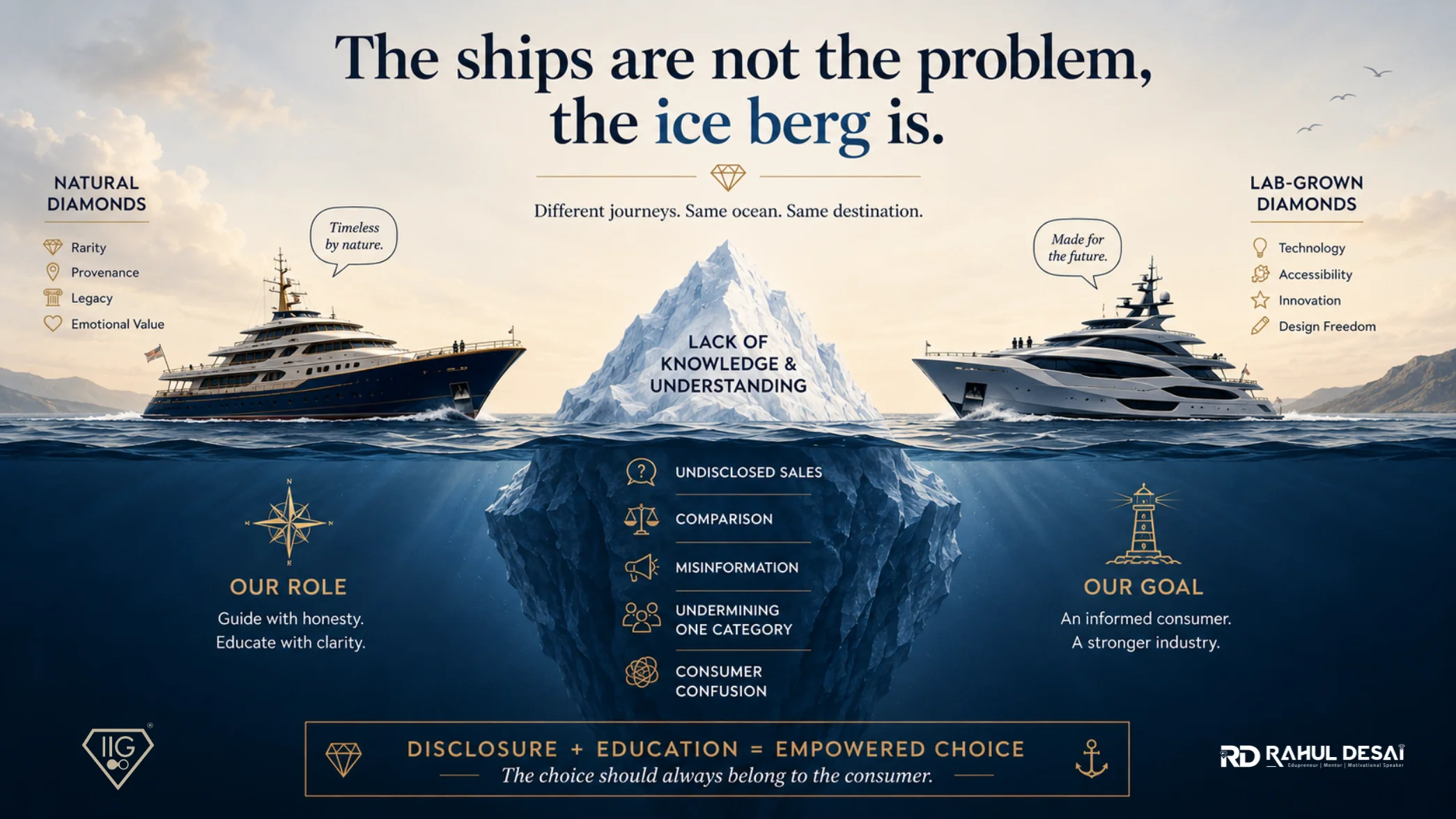
But time has revealed something important. Lab-grown diamonds are not a threat simply because they exist. Natural diamonds are not weakened simply because another category has entered the market. The real threat is not the ship. The real threat is the iceberg.
Two Ships, Different Voyages
If natural diamonds are one ship and lab-grown diamonds are another, they are not destined to crash into each other and sink. They can sail in the same ocean, serving different consumers, different occasions, and different aspirations. What can damage either category is the unseen iceberg beneath the surface: undisclosed selling, poor education, misleading comparisons, misinformation, consumer confusion, and the habit of undermining one product in order to elevate another.
This is the conversation the industry must have with honesty.
Natural diamonds have built their identity over generations. They are associated with rarity, legacy, permanence, and emotional symbolism. They carry the story of the earth, time, and tradition. For many consumers, that story matters deeply. A natural diamond is not only a product, it is often positioned as an heirloom, a marker of commitment, and a piece of history.
Lab-grown diamonds have crafted a different identity. They represent modern choice, accessibility, design freedom, and everyday wearability. They have allowed consumers to explore larger sizes, contemporary jewelry, and fashion-forward pieces at a more approachable price point. For many buyers, lab-grown diamonds are not pretending to be natural diamonds. They are attractive because they offer their own kind of value.
The Real Risk Lies Beneath the Surface
The problem begins when the industry refuses to let both identities stand with dignity. Recently one of my industry colleagues called a natural diamond a ship and lab grown a boat.
Calling one category a “ship” and the other a “boat” is not a strategy. It is insecurity disguised as commentary. Reducing one category to protect the other does not help retailers, manufacturers, or consumers. In fact, it does the opposite. It weakens trust. And trust is the true currency of the diamond business.
Consumers today are more informed, more curious, and more willing to ask questions. They do not need to be pushed into one category through fear or half-truths. They need clarity. They need disclosure. They need a retailer who can explain what each product is, what it is not, why it is priced the way it is, and what kind of emotional or practical value it may hold for them.
The Edupreneur’s Responsibility
As an Edupreneur, my goal is not to take sides. My goal is to guide with honesty and educate with clarity. The future of the diamond industry will not be built by choosing natural over lab-grown, or lab-grown over natural. It will be built by helping each category flourish in its own lane.
That responsibility begins at the retail counter. Every sale must be transparent. Every product must be represented correctly. Every comparison must be fair. If a customer is buying a natural diamond, they should understand its rarity, origin, grading, and long-term positioning. If a customer is buying a lab-grown diamond, they should understand its creation, value proposition, pricing dynamics, and place in the jewelry market.
Disclosure Builds Confidence
Disclosure is not a formality. It is the foundation of confidence. Education is not an added service. It is the future of the industry.
Both categories need education because both categories have consumers who deserve to make empowered choices and thus we need to train retailers to handle objections and questions more effectively. When a buyer understands the difference, they do not feel misled. They feel respected. And a respected consumer becomes a stronger ambassador for the industry.
The iceberg is not lab-grown diamonds. The iceberg is not natural diamonds. The iceberg is confusion, silence, and careless selling.
If we avoid that iceberg together, both ships can sail forward with strength.